-
Spices
Photograph by Penny De Los Santos
Penny De Los Santos is an award-winning documentary photographer for whom food photography is a gateway to exploring and celebrating culture, history, and community. She is a senior contributing photographer to Saveur magazine and a contributing photographer to National Geographic magazine.
Ingredients
The options for photographing food are endless; it's an incredibly visual subject. One thing to remember when starting out is that food photography is just like any other photography—the same principles of light, color, and composition apply.
In the case of the image above, I was prepping for a photograph on a cookbook shoot when I noticed the colorful ingredients for the next shot on the counter where the food stylist was working. We both realized that this was a photograph. The prop stylist, food stylist, and I then brainstormed ideas to create this image. —Penny De Los Santos
Photo Tip: When thinking about food photography, don’t just consider the finished product on the plate or the people eating it. Look at the ingredients—perhaps there’s a beautiful photograph waiting to be made.
-
Citrus Vendor
Photograph by Penny De Los Santos
Connections
What I love about food photography is that it combines the two photography subjects that most resonate with me: culture and how we connect with food. For me, a food photographer is a visual food anthropologist. It's not just about food on a plate, but it's also about everything around it—the moments, the connections, the scenes, the places, the stories.
This image is from a long-term project I did for National Geographic magazine on life in a town near the Texas-Mexico border. This young family sells citrus from the trunk of their car at a Sunday flea market. This is a region known for its citrus groves and orchards, and this scene revealed to me the lives of the people who work in the industry. It was an extraordinary scene to see: a trunk packed with fruit. It’s not something you see everyday, and it evokes several ideas and asks so many questions. —Penny De Los Santos
Photo Tip: Think about how people relate to food and what connects them to it. Trust me, some of the most interesting photographs come out of this relationship.
-
Sandwich, Mexico
Photograph by Penny De Los Santos
Street Food
No matter where I’ve been in the world, street food has given me the opportunity to photograph culturally interesting and engaging scenes. I always make a point of stopping at random food stalls and markets in any city or village I'm in. This is where the locals are, where the everyday people gather. This image, made in a market in Mexico City, is of a regional sandwich filled with potatoes and chorizo and dipped in a guajillo sauce.
When shooting food from food stalls I have a few standard rules: Get extra plates, napkins, utensils, and condiments, and in some cases order two of the same dish (not to eat, of course, but to shoot). —Penny De Los Santos
Photo Tip: Street food that’s extra saucy and messy can look great on camera, but keep in mind that you should be able to identify it. Try replating the dish and even adding more of one of its ingredients if it needs a boost of color. If it has a lime, for instance, ask for an extra, squeeze it on the food, then place it on the plate before photographing. Remember that you want people's mouths to water. If your mouth doesn't water when looking at the food, no one else's will either.
-
Wait Staff, California
Photograph by Penny De Los Santos
Context
When I’m on an assignment I’m always thinking about sense of place and how I can put my subject into context by giving an idea of location. The best way to ensure you have the opportunity to capture context is to show up early and stay late with your subject. It gets you, the photographer, more mentally prepared for the experience of the subject. It also helps you anticipate where your photographs might be. Whenever I get an assignment to profile a chef, for instance, I always head to the location early, get to know the staff, and ask questions.
These types of photographs can be the some of the hardest to make—you have to look beyond clichés and obvious shots for something more interesting and illustrative of your subject. —Penny De Los Santos
Photo Tip: When shooting an assignment, arrive early to give yourself time to get a feel for the overall context of the situation or subject you’ll be photographing.
-
Salsa
Photograph by Penny De Los Santos
Landscapes
Food scenes, or landscapes, are images with multiple elements that give viewers the feeling of sitting at a table. Landscapes are fun to make. They take time and thought, but they can really add to the storytelling power of a food photograph. —Penny De Los Santos
Photo Tip: When making a food landscape, think about how to tell a story with food: Use messy spoons to convey movement, add drips and crumbs for emotion, and give the scene tension with compositionally placed ingredients.
-
Cooks, Los Angeles
Photograph by Penny De Los Santos
Behind-the-Scenes Moments
When I'm looking for moments around food, I always go to where it’s being prepared and where the workers are on break. Going behind the scenes can give you the best opportunity to see moments, especially in restaurants. Staff meals can be hidden treasures for photographs. —Penny De Los Santos
Photo Tip: Remember to check out all parts of a location, including the ones that the public never sees—it could visually pay off.
-
Tortilla Factory
Photograph by Penny De Los Santos
Sense of Place
Food photography, like any kind of photography, should tell a story. If your photos lack a story, maybe you aren't seeing your subjects in the right way. This photo was taken in a desolate, remote part of the Texas Panhandle. I was on assignment for a food magazine that wanted to do a piece on this famous, family-owned tortilla factory that made corn tortillas and chips. I drove hours to get there only to discover that it was a dark warehouse with one tiny window. After spending much of the time photographing the process of making the tortillas, I started to think about the space and how it felt, the vastness of it and how tiny the workers seemed and how mass-produced the product was. I started to really think about photographing in that vein, thinking about the subject in relation to the space. The image then started to say something else entirely. It started to be more intriguing and interesting. —Penny De Los Santos
Photo Tip: Always think about space and how it relates to the subject. Show how it feels to be where you are—give your photograph a sense of place.
-
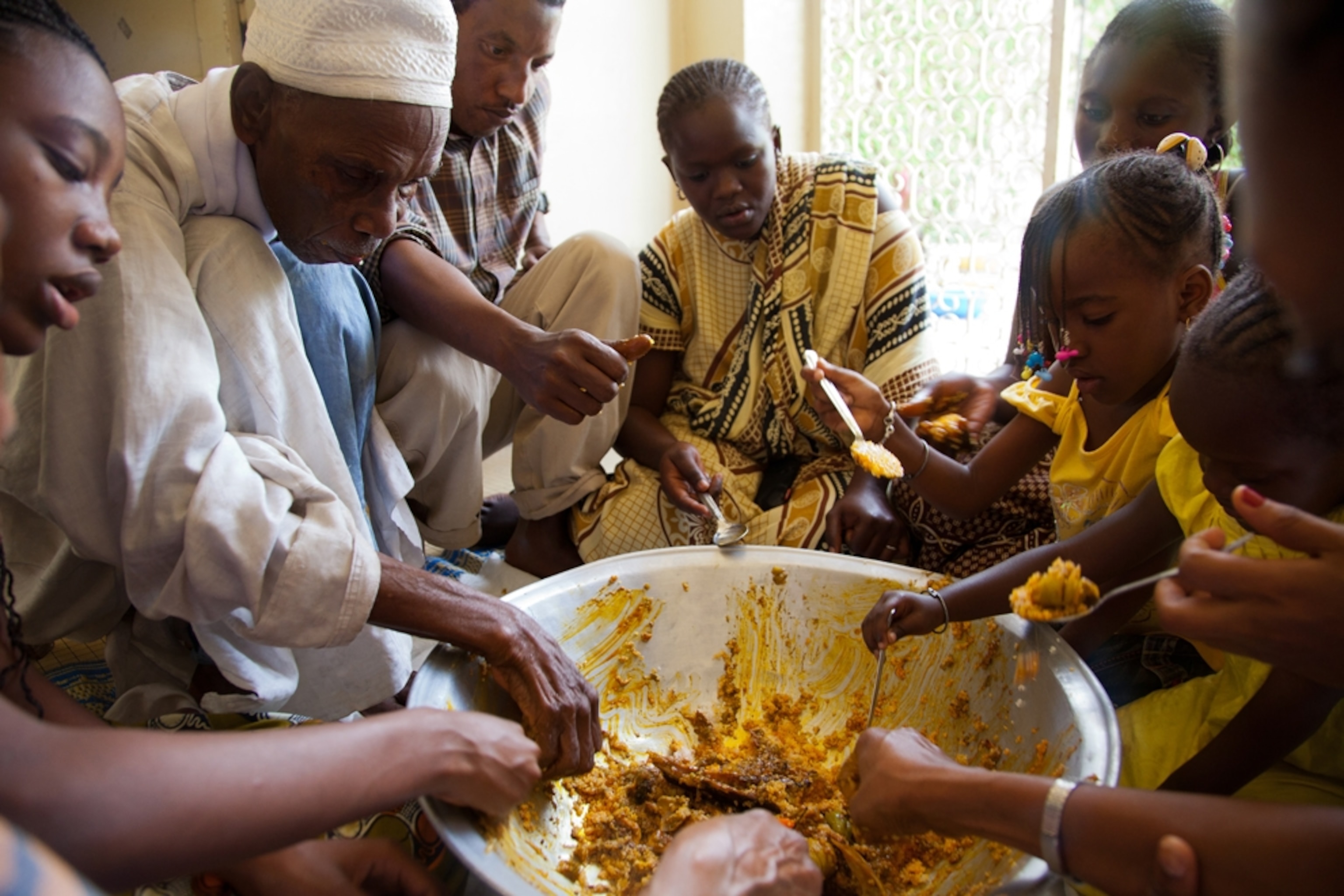
Family Meal, Dakar
Photograph by Penny De Los Santos
Gatherings
The reason I’m so drawn to food as a subject is because of its ability to connect each and every one of us. It forces us to gather at least once a day and share a moment together—around a table, over a drink, at a counter. It peels away our differences and gives us a commonality. As a photographer, it’s these moments that I look for; it's usually where great photographs happen.
This image is from a shoot I did on Senegalese food. After spending the entire day photographing this woman and her daughters as they made thiebou jen, the national dish of Senegal, I found that the true moment was when they all sat down to eat together, sitting close, all reaching into the same bowl. Visually it told the story—that was the photograph. —Penny De Los Santos
Photo Tip: When I’m on a shoot and the story is about food, I always stay to see how people gather around the table and share the meal. To me it's the most revealing moment about the culture I’m in.
-
Chocoflan Desserts
Photograph by Penny De Los Santos
Composition
The three main angles used in food photography are three-quarter, side view, and overhead. Look at still life compositions with the idea of exploring each of these angles, and always remember that you’re looking for the best possible way to show the food. Also, whatever elements you add to a food photograph should make sense. For example, including a knife in the image above wouldn’t have been a good choice because flan is typically eaten with a fork or spoon. —Penny De Los Santos
Photo Tip: When exploring different angles, try to keep the featured food the main element in the image. Be careful of adding any elements that may compete with or distract from your primary subject.
-
Tea Break, India
Photograph by Penny De Los Santos
Spontaneous Moments
The moments that happen around food are endless, which is why I love it as a subject. I was in a market in Delhi, India, when I saw all these men in red coats. I started following them. They weaved through alleys, zoomed past stalls, and ended up here in this tea stall. They were on their break from work at the nearby train station. I stayed with them the entire break, photographing them drinking their tea. —Penny De Los Santos
Photo Tip: Look for the spontaneous “moments” that happen around food, especially in a cultural setting. And always be alert—what may seem like an incidental detail, like a flash of color, can lead you to something you otherwise might have missed.
Featured Photo Tips
Advertisement
-
Steady Hands and Fins
Photographer David Doubilet photographs stingrays, sharks, and more.
-
Survival Guide: Dodging Locusts
Swarm behaviorist Iain Couzin has a toxic reaction to a locust at the same time his team runs out of food.
Nat Geo Photo Workshops
Special Offers
-
National Geographic
Subscribe to National Geographic magazine and save. Print and digital editions available.